This notebook contains all the code examples from Section 2.2 Multiple random variables in the No Bullshit Guide to Statistics.
Notebook setup
# Ensure required Python modules are installed
%pip install --quiet numpy scipy seaborn
[notice] A new release of pip is available: 26.0.1 -> 26.1.2
[notice] To update, run: pip install --upgrade pip
Note: you may need to restart the kernel to use updated packages.
# load Python modules
import matplotlib.pyplot as plt  # generic plotting functions
import numpy as np               # numerical calculations
import pandas as pd              # data frames to store joint PMFs
import seaborn as sns            # plotting distributions
# Figures setup
plt.clf() # needed otherwise `sns.set_theme` doesn't work
sns.set_theme(
context="paper",
style="whitegrid",
palette="colorblind",
rc={"font.family": "serif",
"font.serif": ["Palatino", "DejaVu Serif", "serif"],
"figure.figsize": (5,3)},
)
%config InlineBackend.figure_format = 'retina'<Figure size 640x480 with 0 Axes># Simple float __repr__
import numpy as np
if int(np.__version__.split(".")[0]) >= 2:
np.set_printoptions(legacy='1.25')
# set random seed for repeatability
np.random.seed(42)Definitions
pXY = [[ 0.1, 0.05, 0.02, 0.01, 0.01],
       [0.06, 0.12, 0.06, 0.03, 0.03],
       [0.02, 0.06, 0.12, 0.07, 0.02],
       [0.01, 0.01, 0.05,  0.1, 0.05]]
jpmfXY = pd.DataFrame(data=pXY,
                      index=["a", "b", "c", "d"],
                      columns=[1,2,3,4,5])
jpmfXY.columns.name = "X"
jpmfXY.index.name = "Y"
# print(jpmfXY.sum().sum())
jpmfXY
Loading...
from ministats.plots.probability import plot_joint_pmf_stems
ax = plot_joint_pmf_stems(jpmfXY.T, zmax=0.2)
# ax.view_init(elev=30, azim=-30)
# ax.set_box_aspect((4, 5, 3))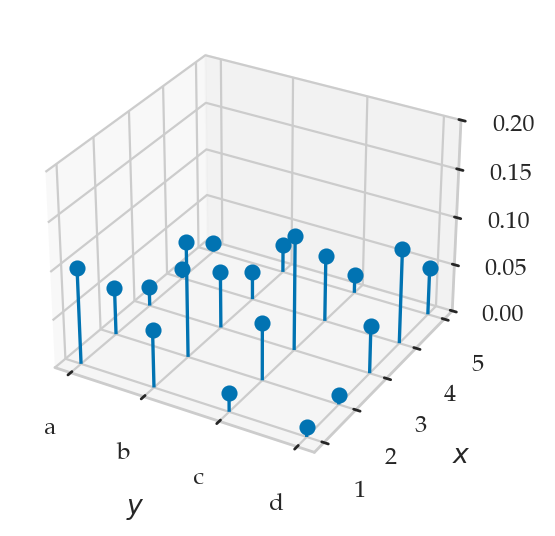
from ministats.plots.probability import plot_joint_pmf_balloons
plot_joint_pmf_balloons(jpmfXY);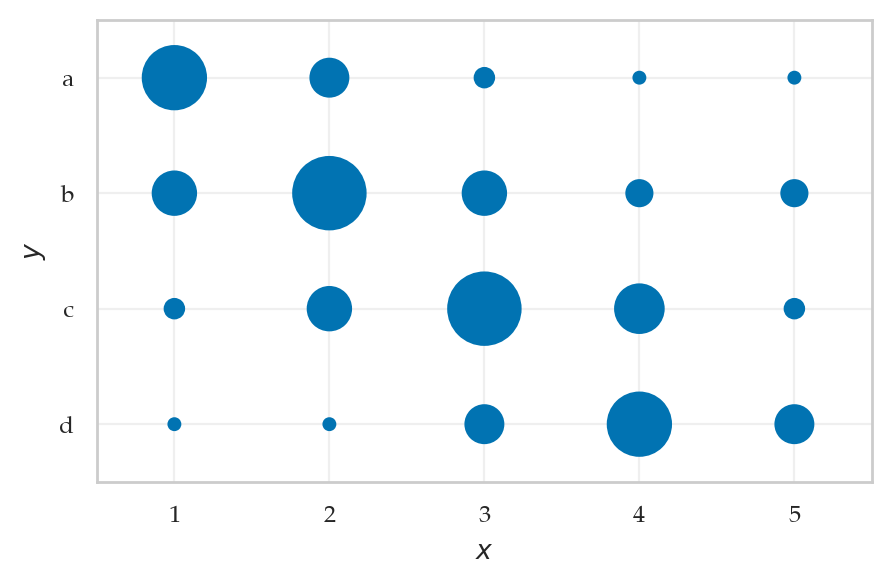
print(sum(jpmfXY.loc["b"]))
print(jpmfXY.loc["b"].values)
print(jpmfXY.loc["b"].values / sum(jpmfXY.loc["b"]))
0.3
[0.06 0.12 0.06 0.03 0.03]
[0.2 0.4 0.2 0.1 0.1]
from ministats.book.tables import joint_pmf_to_array
joint_pmf_to_array(jpmfXY, sigfigs=3)
Loading...
Marginal distributions
Conditional distributions
Joint probability distributions
Example 1: two coin tosses
def fC(c):
    if c in ["heads", "tails"]:
        return 1/2
    else:
        return 0

def fC1C2(c1,c2):
    return fC(c1) * fC(c2)

for c1 in ["heads", "tails"]:
    for c2 in ["heads", "tails"]:
        print("Pr(" + c1 + "," + c2 + ") =", fC1C2(c1,c2))
Pr(heads,heads) = 0.25
Pr(heads,tails) = 0.25
Pr(tails,heads) = 0.25
Pr(tails,tails) = 0.25
import pandas as pd

#        C1=heads    C1=tails
pC1C2 = [[0.25,      0.25   ],   # C2=heads
         [0.25,      0.25   ]]   # C2=tails

jpmfC1C2 = pd.DataFrame(data=pC1C2,
                        columns=["heads", "tails"],
                        index=["heads", "tails"])
jpmfC1C2.columns.name = "C_1"
jpmfC1C2.index.name = "C_2"
from ministats.book.tables import joint_pmf_to_array
joint_pmf_to_array(jpmfC1C2, sigfigs=3)Loading...
from ministats.plots.probability import plot_joint_pmf_stems

plot_joint_pmf_stems(jpmfC1C2, zmax=0.3);
ax.text2D(1.15, 0.56, "$f_{C_1C_2}$", transform=ax.transAxes,
          fontsize=plt.rcParams["axes.labelsize"],
          rotation=90, va="center", ha="center");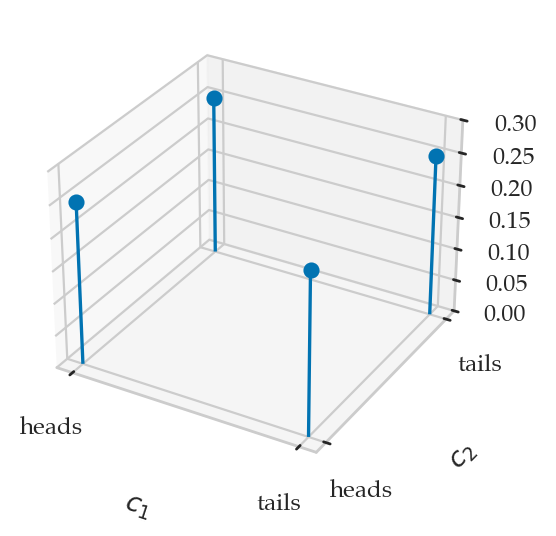
from ministats.plots.probability import plot_joint_pmf_balloons
plot_joint_pmf_balloons(jpmfC1C2);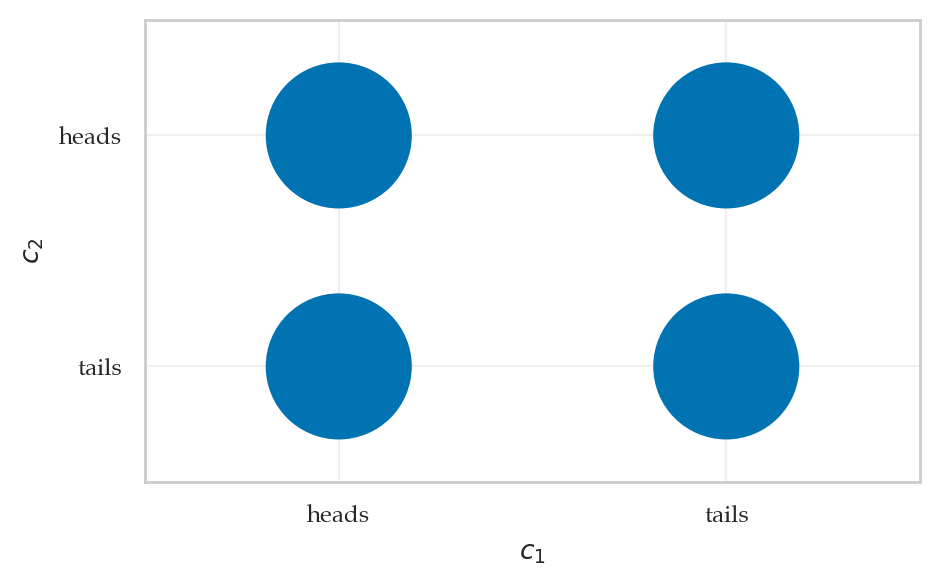
TODO: show tree diagram
# Define the outcomes of the event "at least one heads"
event = [("heads","tails"), ("tails","heads"), ("heads","heads")]

# Probability the event {at least one `heads`}
sum([fC1C2(c1,c2) for (c1,c2) in event])0.75Example 2: rolling two dice
def fD(d):
    if d in [1,2,3,4,5,6]:
        return 1/6
    else:
        return 0

def fD1D2(d1,d2):
    return fD(d1) * fD(d2)
#         D1=1  D1=2  D1=3  D1=4  D1=5  D1=6
pD1D2 = [[1/36, 1/36, 1/36, 1/36, 1/36, 1/36],  # D2=1
         [1/36, 1/36, 1/36, 1/36, 1/36, 1/36],  # D2=2
         [1/36, 1/36, 1/36, 1/36, 1/36, 1/36],  # D2=3
         [1/36, 1/36, 1/36, 1/36, 1/36, 1/36],  # D2=4
         [1/36, 1/36, 1/36, 1/36, 1/36, 1/36],  # D2=5
         [1/36, 1/36, 1/36, 1/36, 1/36, 1/36]]  # D2=6
jpmfD1D2 = pd.DataFrame(data=pD1D2,
                        columns=[1,2,3,4,5,6],
                        index=[1,2,3,4,5,6])
jpmfD1D2.columns.name = "D_1"
jpmfD1D2.index.name = "D_2"
joint_pmf_to_array(jpmfD1D2, sigfigs=3)Loading...
from ministats.plots.probability import plot_joint_pmf_stems
plot_joint_pmf_stems(jpmfD1D2.T, zmax=0.045);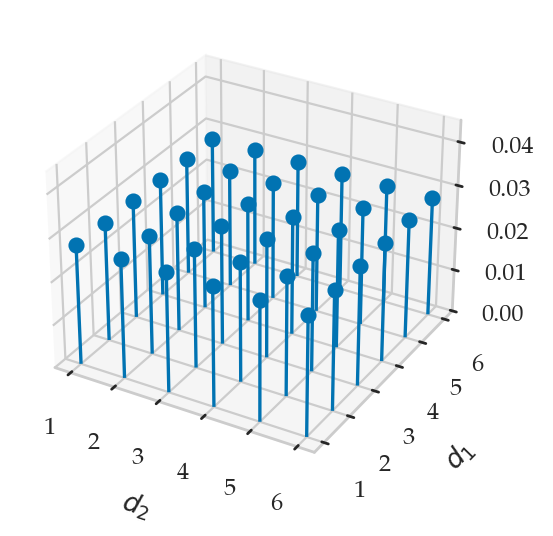
from ministats.plots.probability import plot_joint_pmf_balloons
plot_joint_pmf_balloons(jpmfD1D2);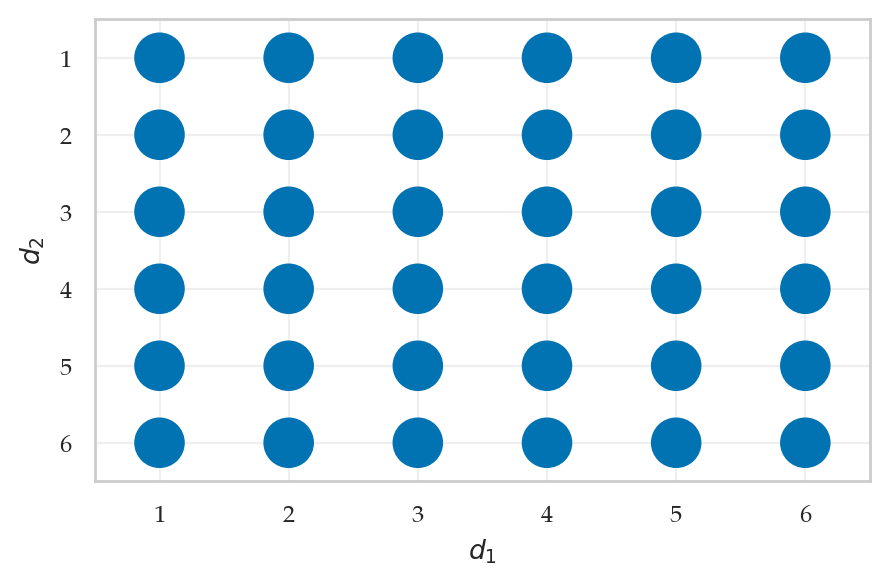
sum_to_seven = [(1,6),(2,5),(3,4),(4,3),(5,2),(6,1)]
plot_joint_pmf_balloons(jpmfD1D2, highlight=sum_to_seven);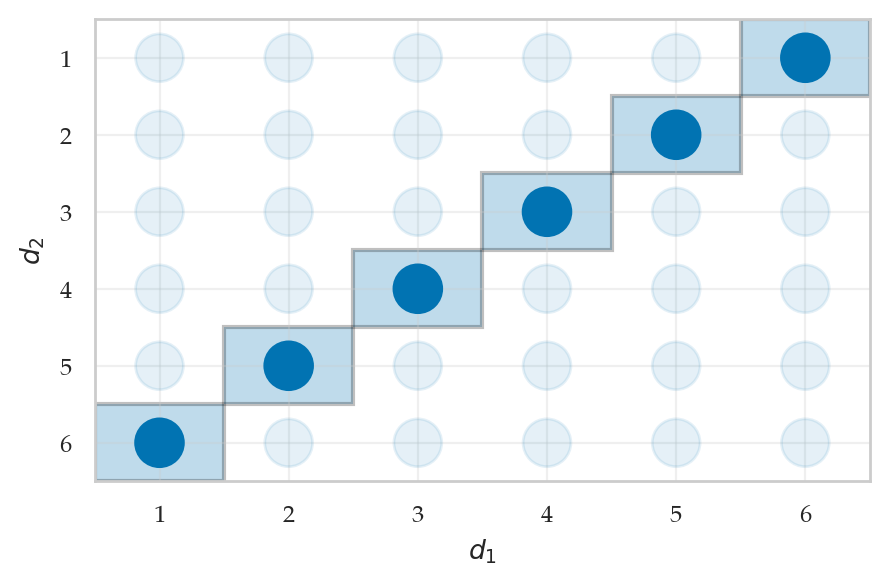
Marginal distribution functions
joint_pmf_to_array(jpmfXY, sigfigs=2, margins=True)Loading...
from ministats.plots.probability import plot_joint_pmf_and_marginals
plot_joint_pmf_and_marginals(jpmfXY);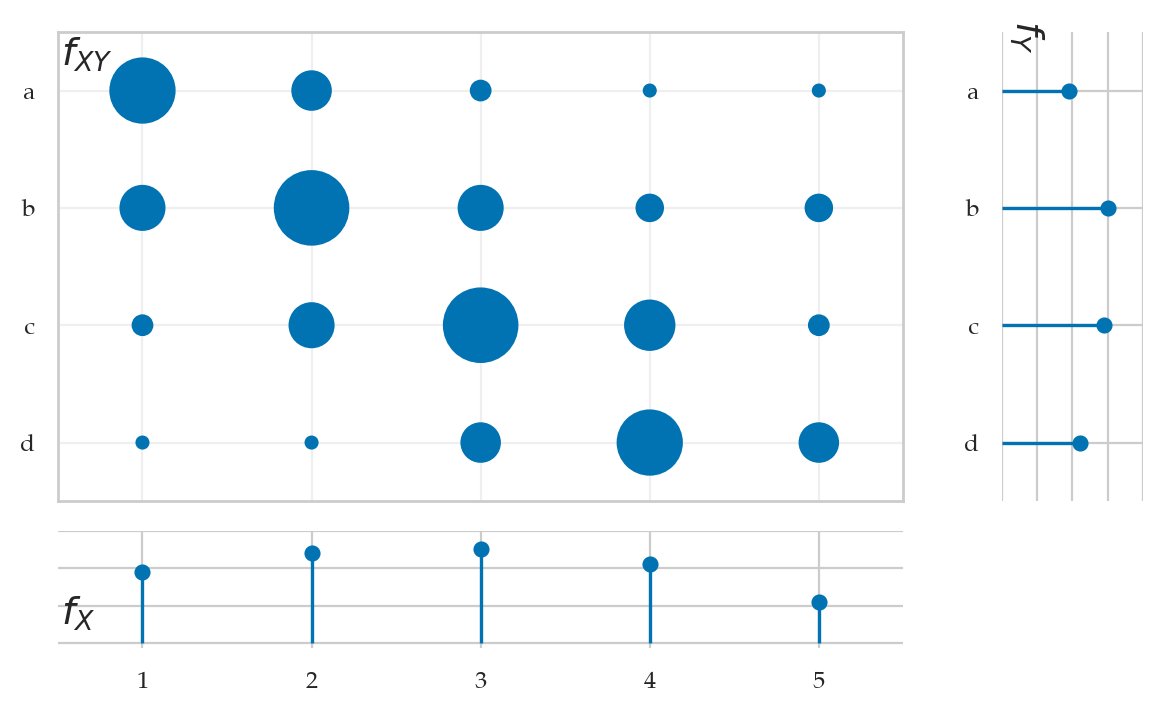
Conditional distributions
from ministats.plots.probability import plot_joint_pmf_and_conditional
plot_joint_pmf_and_conditional(jpmfXY, given="y");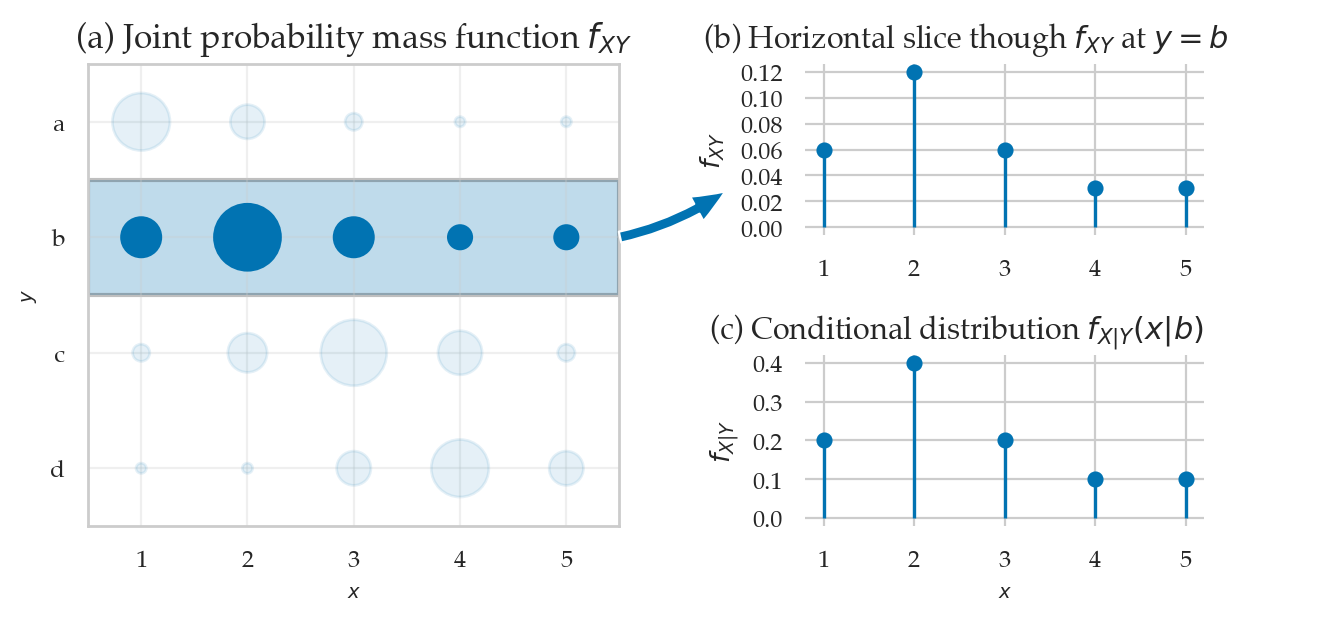
The conditional distribution is obtained as follows.
# f_{X|Y}(x|y=b)
jpmfXY.loc["b",:] / jpmfXY.loc["b",:].sum()
X
1 0.2
2 0.4
3 0.2
4 0.1
5 0.1
Name: b, dtype: float64plot_joint_pmf_and_conditional(jpmfXY, given="x");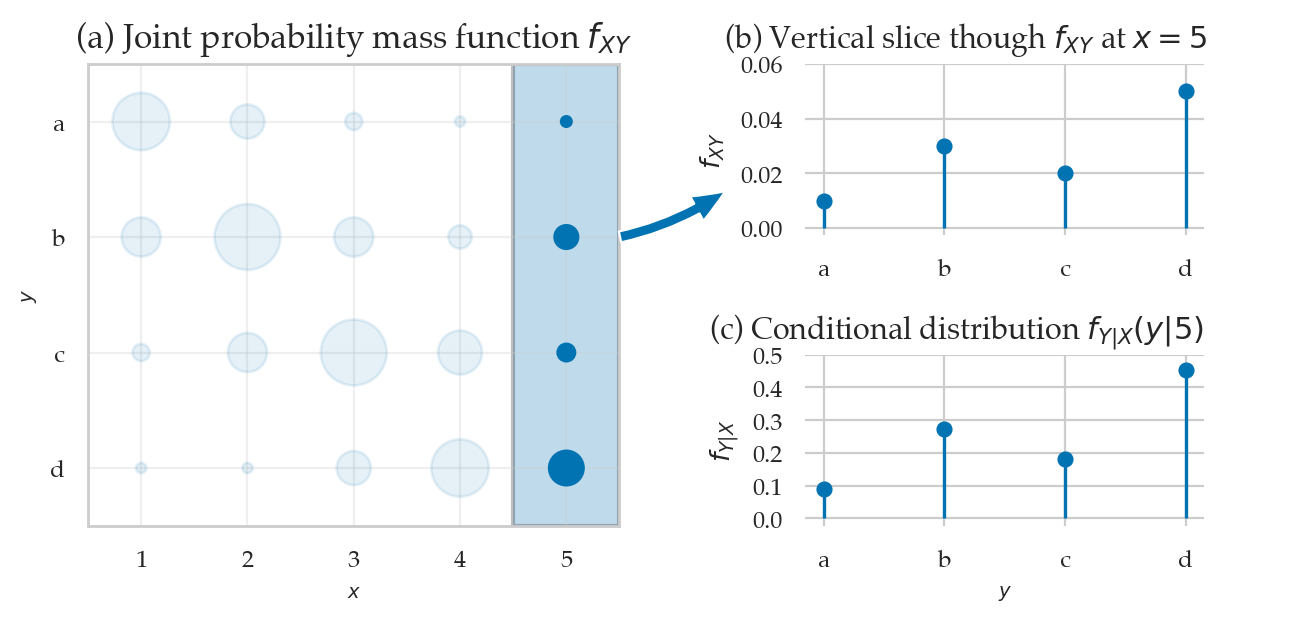
The conditional distribution is obtained as follows.
# f_{Y|X}(y|x=5)
jpmfXY.loc[:,5] / jpmfXY.loc[:,5].sum()
Y
a 0.090909
b 0.272727
c 0.181818
d 0.454545
Name: 5, dtype: float64Example 3: coin-dependent dice roll
def fC(c):
    if c in ["heads", "tails"]:
        return 1/2
    else:
        return 0

def fD6(d):
    if d in [1,2,3,4,5,6]:
        return 1/6
    else:
        return 0

def fD4(d):
    if d in [1,2,3,4]:
        return 1/4
    else:
        return 0

def fDC(d,c):
    if c == "heads":
        return fC(c) * fD6(d)
    elif c == "tails":
        return fC(c) * fD4(d)

for c in ["heads", "tails"]:
    for d in [1,2,3,4,5,6]:
        print("Pr(" + str(d) + "," + c + ") =", round(fDC(d,c),4))
Pr(1,heads) = 0.0833
Pr(2,heads) = 0.0833
Pr(3,heads) = 0.0833
Pr(4,heads) = 0.0833
Pr(5,heads) = 0.0833
Pr(6,heads) = 0.0833
Pr(1,tails) = 0.125
Pr(2,tails) = 0.125
Pr(3,tails) = 0.125
Pr(4,tails) = 0.125
Pr(5,tails) = 0.0
Pr(6,tails) = 0.0
sum(fDC(d,c) for d in [1,2,3,4,5,6] for c in ["heads", "tails"])1.0# f_{Y|X}(y|heads) [as a list]
[fDC(d,"heads") for d in range(1,6+1)][0.08333333333333333,
0.08333333333333333,
0.08333333333333333,
0.08333333333333333,
0.08333333333333333,
0.08333333333333333]# f_{Y|X}(y|tails) [as a list]
[fDC(d,"tails") for d in range(1,6+1)][0.125, 0.125, 0.125, 0.125, 0.0, 0.0]# f_Y(y) [as a list]
fDs = [fDC(d,"heads")+fDC(d,"tails") for d in range(1,6+1)]
fDs[0.20833333333333331,
0.20833333333333331,
0.20833333333333331,
0.20833333333333331,
0.08333333333333333,
0.08333333333333333]# ALT. compute f_{D|C}(d|heads)*0.5 + f_{D|C}(d|tails)*0.5
fDs = [fD6(d)*0.5+fD4(d)*0.5 for d in range(1,6+1)]
fDs[0.20833333333333331,
0.20833333333333331,
0.20833333333333331,
0.20833333333333331,
0.08333333333333333,
0.08333333333333333]sum(fDs)0.9999999999999999import pandas as pd
# D=1 D=3 D=3 D=4 D=5 D=6
pDC = [[1/12, 1/12, 1/12, 1/12, 1/12, 1/12], # C=heads
[1/8, 1/8, 1/8, 1/8, 0, 0]] # C=tails
jpmfDC = pd.DataFrame(data=pDC,
index=["heads","tails"],
columns=[1,2,3,4,5,6])
jpmfDC.columns.name = "D"
jpmfDC.index.name = "C"from ministats.book.tables import joint_pmf_to_array
joint_pmf_to_array(jpmfDC, sigfigs=3, margins=True)Loading...
from ministats.plots.probability import plot_joint_pmf_stems
ax = plot_joint_pmf_stems(jpmfDC.T)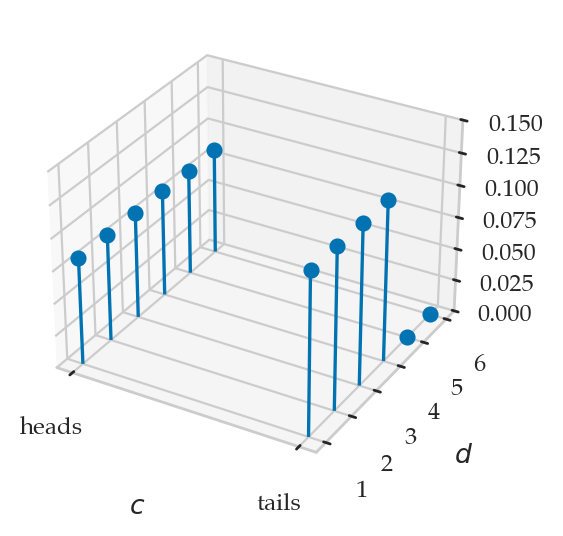
from ministats.plots.probability import plot_joint_pmf_balloons
plot_joint_pmf_balloons(jpmfDC);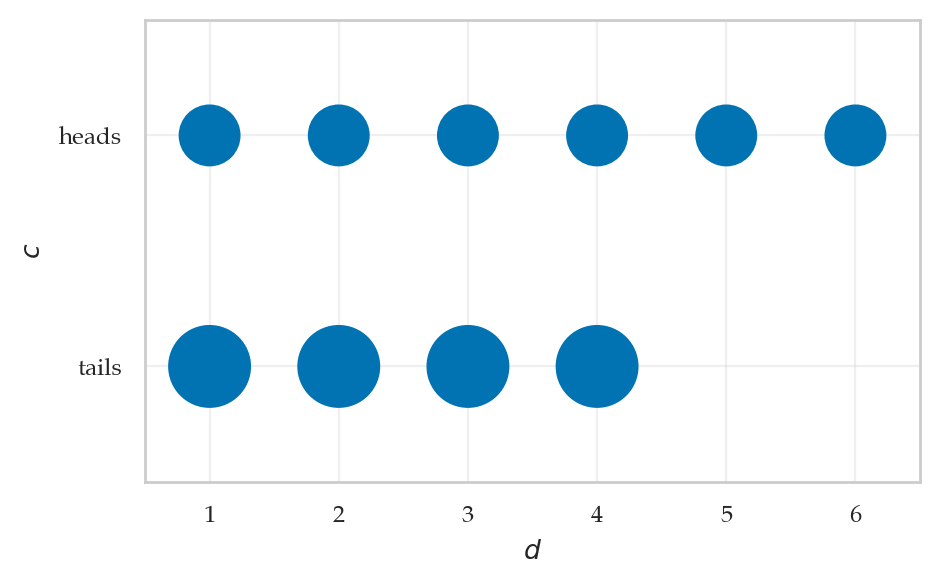
Example 4: diagnostic test
def fV(v):
    if v == 1:
        return 0.03
    elif v == 0:
        return 0.97

def fTgivenV1(t):
    if t == 1:
        return 0.90
    elif t == 0:
        return 0.10

def fTgivenV0(t):
    if t == 1:
        return 0.20
    elif t == 0:
        return 0.80

def fTgivenV(t,v):
    if v == 1:
        return fTgivenV1(t)
    elif v == 0:
        return fTgivenV0(t)

def fTV(t,v):
    return fTgivenV(t,v) * fV(v)

for v in range(0,1+1):
    for t in range(0,1+1):
        print("Pr({T=" + str(t) + ",V=" + str(v)+"})",
              "=", fTgivenV(t,v), "*", fV(v),
              "=", round(fTV(t,v),4))
Pr({T=0,V=0}) = 0.8 * 0.97 = 0.776
Pr({T=1,V=0}) = 0.2 * 0.97 = 0.194
Pr({T=0,V=1}) = 0.1 * 0.03 = 0.003
Pr({T=1,V=1}) = 0.9 * 0.03 = 0.027
import pandas as pd

#              T = 0           T = 1
pTV = [[       0.8*0.97,  (1-0.8)*0.97],    #   V = 0
        [  (1-0.9)*0.03,      0.9*0.03]]    #   V = 1

jpmfTV = pd.DataFrame(data=pTV, columns=[0,1], index=[0,1])
jpmfTV.columns.name = "T"
jpmfTV.index.name = "V"
plot_joint_pmf_stems(jpmfTV.T);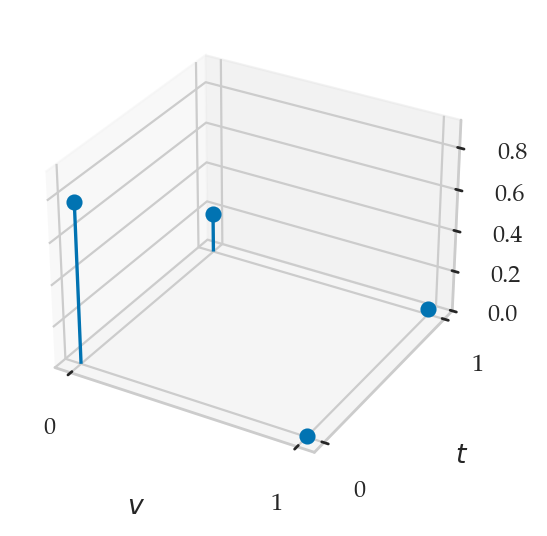
from ministats.plots.probability import plot_joint_pmf_balloons
plot_joint_pmf_balloons(jpmfTV, size_exponent=1);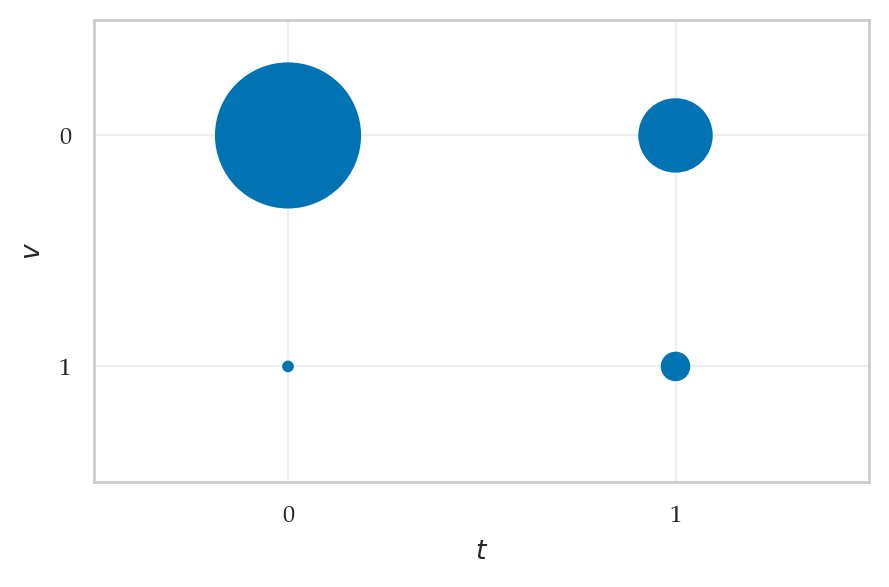
from ministats.book.tables import joint_pmf_to_array
joint_pmf_to_array(jpmfTV, sigfigs=3, margins=True)
Loading...
# f_T(0) =
0.8 * 0.97 + 0.10 * 0.030.779# f_T(1) =
0.2 * 0.97 + 0.90 * 0.030.221for t in range(0,1+1):
fTt = fTV(t,0) + fTV(t,1)
print("Pr({T="+str(t)+"}) =", fTt)Pr({T=0}) = 0.779
Pr({T=1}) = 0.221
Bayes’ rule
Example 4: diagnostic test (continued)
We’re now interested in , which we can obtain using Bayes’ theorem.
We’ll now define the function fVgivenT that computes the numerator
and denominator in this fraction,
and returns the ratio.
def fVgivenT(v,t):
    num = fTgivenV(t,v) * fV(v)
    denom = fTgivenV(t,0) * fV(0) + fTgivenV(t,1) * fV(1)
    return num / denom
The probability of the patient having the virus , given they tested positive is:
fVgivenT(1,1)0.12217194570135746Intuitively, this percentage is measuring the ratio of the probability of the outcome divided by sum of the probabilities of all outcomes where positive test can occur: .
fTV(1,1) / (fTV(1,0) + fTV(1,1))0.12217194570135746Independent random variables
Formulas for independent random variables
Independent, identically distributed variables
Example 5: tossing a coin times
Example 6: rolling a die times
Discussion
Dependence and independence
Exercises
See the notebook sec22