
Descriptive statistics exercises#
This notebook contains all solutions of the exercises from Section 1.3 Descriptive Statistics in the No Bullshit Guide to Statistics.
Notebooks setup#
import numpy as np
import pandas as pd
import matplotlib.pyplot as plt
import seaborn as sns
# Figures setup
sns.set_theme(
    context="paper",
    style="whitegrid",
    palette="colorblind",
    rc={'figure.figsize': (4,2)},
)

%config InlineBackend.figure_format = 'retina'
# Set pandas precision
pd.set_option("display.precision", 2)
# Simple float __repr__
import numpy as np
if int(np.__version__.split(".")[0]) >= 2:
    np.set_printoptions(legacy='1.25')
# Download datasets/ directory if necessary
from ministats import ensure_datasets
ensure_datasets()
datasets/ directory already exists.
Exercises 1: numerical variables#
E1.16#
Compute the \(\mathbf{mean}\), \(\mathbf{min}\), \(\mathbf{max}\), and
\(\mathbf{range}\) of the effort variable in the students dataset
datasets/students.csv.
import pandas as pd
students = pd.read_csv("datasets/students.csv")
efforts = students["effort"]
E1.17#
Calculate the first quartile \(\mathbf{Q}_{1}\),
the median \(\mathbf{med}\),
and the third quartile \(\mathbf{Q}_{3}\) of
the effort variable in the students dataset.
E1.18#
Make a one-way frequency table for the effort variable using \([5,7)\),
\([7,9)\), \([9,11)\), and \([11,13)\) as the bin intervals.
E1.19#
Consider the following Spear–Tukey box plot of the variable~\(\mathbf{y}\).
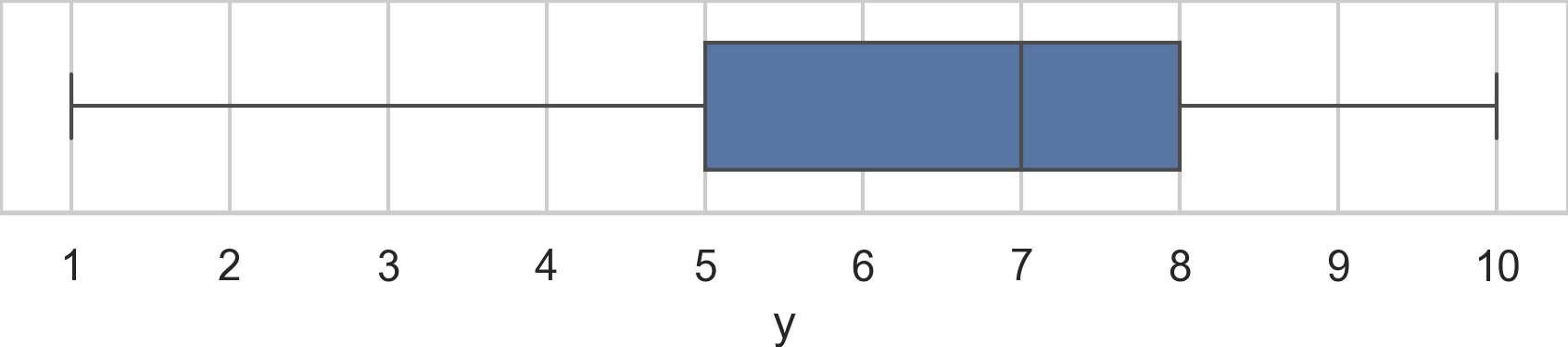
Determine the values of the following descriptive statistics: \(\textbf{med}(\mathbf{y})\), \(\textbf{min}(\mathbf{y})\), \(\textbf{max}(\mathbf{y})\), \(\textbf{Q}_{1}(\mathbf{y})\), \(\textbf{Q}_{2}(\mathbf{y})\), \(\textbf{Q}_{3}(\mathbf{y})\), \(\textbf{IQR}(\mathbf{y})\), and \(\textbf{range}(\mathbf{y})\).
E1.20#
We want to summarize the dataset \(\mathbf{x} = (1, 2, 3, 4, 5, 6, 50)\)
by reporting a pair of numbers: one measure of central tendency and one
measure of dispersion.
a) Compute the mean \(\mathbf{mean}(\mathbf{x})\) and the standard deviation
\(\mathbf{std}(\mathbf{x})\).
b) Find the median \(\mathbf{med}(\mathbf{x})\)
and the interquartile range \(\mathbf{IQR}(\mathbf{x})\).
c) Which pair of numbers provides a more faithful summary?
import pandas as pd
xs = pd.Series([1, 2, 3, 4, 5, 6, 50], name="x")

# a) compute the mean and the standard deviation
# b) compute the median and the interquartile range
Exercises 2: two numerical variables#
E1.21#
in the relationship between the age variable
and the time variable in the players dataset.
a) Draw a scatter plot of time versus age.
b) Calculate the covariance \(\mathbf{cov}(\texttt{age},\texttt{time})\).
c) Calculate the correlation coefficient \(\mathbf{corr}(\texttt{age},\texttt{time})\).
d) Interpret the correlation coefficient. Is this a causal relationship?
players = pd.read_csv("datasets/players.csv")
Exercises 3: comparing two groups of numerical variables#
E1.22#
Compare the electricity prices between the East and West locations in
the electricity prices dataset
datasets/eprices.csv.
a) Generate combined strip plot for the two groups.
b) Compute the mean for each group.
E1.23#
The doctors dataset has the categorical variable loc that represents the location
with two possible values rur and urb.
Compare the score variable between the rur and urb groups of doctors.
a) Generate parallel strip plots.
b) Generate parallel box plots.
c) Generate separate histograms for the two groups.
d) Compute the descriptive statistics for the two groups.
doctors = pd.read_csv("datasets/doctors.csv")
Exercises 4: categorical variables#
E1.24#
Compute frequencies and relative frequencies for the curriculum variable. Display the results in a one-way table.
E1.25#
Make a bar chart displaying the frequencies of the curriculum variable.
E1.26#
What is the mode for variable curriculum in the students dataset?
How many times does the modal value occur in the curriculum data?
Exercises 5: two categorical variables#
E1.27#
The doctors dataset
(datasets/doctors.csv)
contains the categorical variables loc (urb or rur) and work
(cli, eld, or hos).
a) Compute a two-way table for the variables work and loc.
b) Generate a grouped bar plot of work and loc.
c) Generate a stacked bar plot of work and loc.
doctors = pd.read_csv("datasets/doctors.csv")
E1.28#
Load the visitors dataset (datasets/visitors.csv).
a) Compute a two-way table of the variables version and bought.
b) Generate a grouped bar plot of version and bought.
c) Use pd.crosstab to compute the conditional relative frequency of bought=1 for the two versions: \(\mathbf{relfreq}_{\texttt{1}|\texttt{A}}\) and
\(\mathbf{relfreq}_{\texttt{1}|\texttt{B}}\).
visitors = pd.read_csv("datasets/visitors.csv")

# pd.crosstab( ... )
Exercises (end of section)#
E1.29#
Calculate the mean and the standard devoatopm
of the variable score variable
in the doctors dataset.
E1.30#
A research paper includes these graphs for the variable \(\mathbf{x}\).
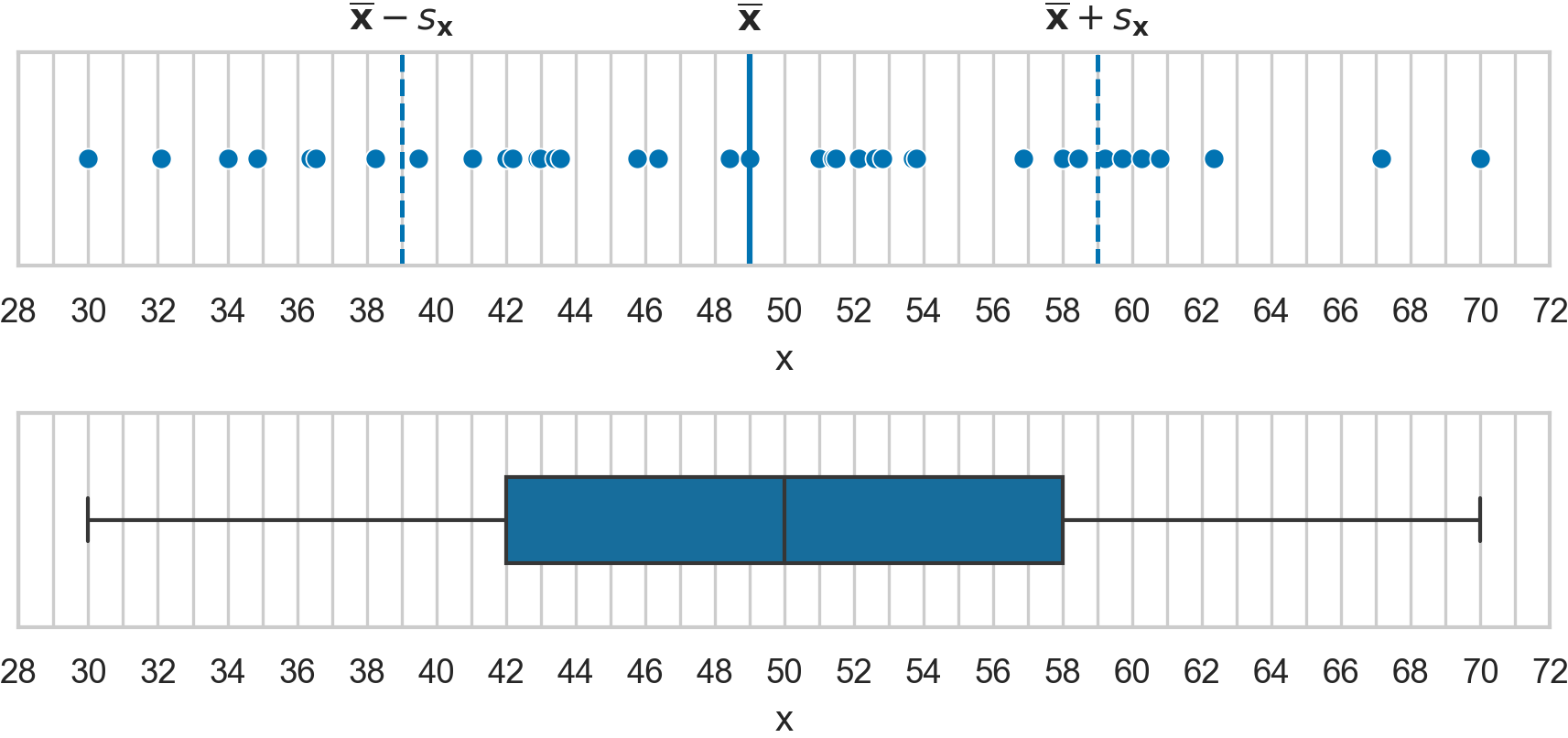
The paper authors forgot to include the summary statistics for the variable \(\mathbf{x}\). Use the graphs to determine the the values of the following descriptive statistics: \(\textbf{mean}(\mathbf{x})\), \(\textbf{med}(\mathbf{x})\), \(\textbf{std}(\mathbf{x})\), \(\textbf{var}(\mathbf{x})\), \(\textbf{min}(\mathbf{x})\), \(\textbf{Q}_{1}(\mathbf{x})\), \(\textbf{Q}_{2}(\mathbf{x})\), \(\textbf{Q}_{3}(\mathbf{x})\), \(\textbf{max}(\mathbf{x})\), \(\textbf{IQR}(\mathbf{x})\), \(\textbf{range}(\mathbf{x})\).